Table of content
Apply for the EFS
Prerequisites (all pathways)
Applying for the EFS is free of charge for ANU staff, but there are some eligibility criteria to consider. EFS applicants must:
- be a current ANU employee, student, or honorary appointee with an ANU email address;
- commit to upholding the AdvanceHE Fellows Code of Practice;
- have undertaken relevant Professional Development;
- be able to contribute to the EFS, for example as EFS mentor, EFS assessor, or speaker.
If you leave ANU before you complete your application, then please email us at clt@anu.edu.au to explain your situation and discuss next steps. Each situation is unique, but here are some common scenarios and information on how we can support applicants:
- If you leave ANU to move to a university that runs a similar program, then we recommend that you complete your application at your new institution.
- If you are on a casual/sessional contract at ANU, and you expect to be re-employed by ANU following a break, then as long as you have been registered in an EFS Program* at least three months prior to your employment break, we will continue to provide mentor support for a further three months or until the next closing date for applications.
- If your employment at ANU ceases, and you have been registered in an EFS Program* for at least three months, then we may be able to support you as a direct applicant to AdvanceHE (subject to on-going funding).
* To be deemed registered in an EFS Program, you need to have attended an EFS Information Session; submitted the completed enrolment form (including a Context Statement); and have been assigned an EFS mentor.
The AdvanceHE Fellowship Code of Practice establishes a set of principles and expectations for individuals gaining Fellowship. The Code embodies the values of teaching professionals in relation to professional practice, learners and colleagues. Adhering to the Code and committing to ‘remaining in good standing’ are crucial to gaining and maintaining Fellowship through the ANU EFS. Upon submitting your EFS application, you will be required to sign a declaration that you will adhere to the Code of Practice.
EFS Pathways
There are three pathways to HEA Fellowship at ANU:
1. THE REFLECTION ON EXPERIENCE (REX) PATHWAY (AFHEA, FHEA, AND SFHEA PATHWAY)
The REx pathway is the most common route at ANU. It provides a scaffolded educational professional development pathway to Associate Fellowship of the Higher Education Academy (AFHEA), Fellowship of the Higher Education Academy (FHEA), and Senior Fellowship of the Higher Education Academy (SFHEA). Learn more about the REx pathway…
2. SUPPORTED DIRECT APPLICATION TO ADVANCE HE (PFHEA PATHWAY)
ANU does not award Principal Fellowship of the Higher Education Academy (PFHEA), but the EFS team can provide mentoring and support for direct application to Advance HE to those who seek to gain this high level of recognition. Email us at clt@anu.edu.au if you wish to learn more.
3. ‘TEACHING IN MEDICINE’ (TIM) PATHWAY (AFHEA PATHWAY)
ANU offers a Teaching in Medicine (TiM) pathway for clinical and other medical educators who wish to apply for AFHEA. Learn more about the TiM pathway below. Note that clinical and other medical educators who wish to apply for a FHEA or SFHEA will need to join the Reflection on Experience (REx) pathway.
This pathway is available through the ‘Teaching for Clinicians’ course run by the Canberra Region Medical Education Council (CRMEC). ‘Teaching for Clinicians’ is a course that is offered to all doctors working across the public health system in Canberra and South-East NSW.
In order to qualify for the TiM pathway to AFHEA, you must be:
- teaching medical students for at least 12 months in the clinical environment;
- fully registered as a medical practitioner;
- have attended the ‘Teaching for Clinicians Course’ Part 1 and Part 2.
This course is run twice yearly and is open to all doctors who are supervising and teaching in the clinical context of patient care.
Assessment via the TiM pathway is available between February and October each year. Applicants will be advised about the application process during the Course and can apply for assessment up to two years post the Course.
Learn more about this pathway at the ‘Canberra Region Medical Education Council’ (CRMEC) website or email us at clt@anu.edu.au.
Why should I apply
Your time is valuable, and applying for a fellowship will require an investment of your time to be successful. So what’s in it for you? By applying for an AdvanceHE fellowship through the EFS, you can acquire the following:
 |
Professional recognition Membership of the EFS provides you with professional recognition of your teaching. Many existing members have reported that membership has helped them obtain new jobs, promotions, and explore new opportunities. |
 |
Collegiality and network Once you are a member of the EFS, not only will you be part of a worldwide community, you will be part of a teaching-focused community within ANU. EFS members have the opportunity to attend scheme-based events, seminars and networking activities. |
 |
A world-wide community When you become a member of the EFS you will be part of a 90,000+ strong global community with an internationally recognised teaching recognition |
 |
A ready-made portfolio The contents of your teaching philosophy and reflective narrative will likely come in handy if you wish to apply for teaching awards or promotions in the future. While you will not be able to reuse your work word for word, the contents will provide an excellent base for you to springboard off of. |
 |
Leadership building Membership of the EFS will also provide you with the opportunity to develop your leadership skills and contribute to the enhancement of teaching and learning across the ANU campus, through mentoring prospective applicants, assessing applications and writing references. |
 |
Personal development Writing a fellowship application requires reflection on your teaching practices, which more often than not, will aid your development as an educator. Reflecting on your practice will prompt you to recognise what you are doing well, appreciate the journey you have taken to date, and in many cases, identify gaps or areas for improvement in your teaching. |
 |
Post nominal letters Once you are a member of the EFS, you are entitled to use the post-nominal of your category after your name (for example, John Smith AFHEA). |
Beyond fellowship
Being a HEA fellow will give you many opportunities for networking and collaborating with your peers across campus and across other institutions in Australasia.
Once awarded fellowship, you will be listed by College and School on the list of ANU EFS Fellows . You will offered opportunities to mentor or assess future applicants, which will contribute to your future professional development and will involve high-level training in mentoring, peer engagement, and dialogic and written assessment against criteria. Learn more by visiting our Communities of Practice page.
Reflection on experience pathway
The Reflection on Experience (REx) pathway provides a scaffolded educational professional development pathway to Associate Fellowship of the Higher Education Academy (AFHEA), Fellowship of the Higher Education Academy (FHEA), and Senior Fellowship of the Higher Education Academy (SFHEA). The pathway is run twice a year in accordance with the ANU Academic Calendar, and is administered by the Education Advancement Team at the ANU Centre for Learning & Teaching. You can reach us via clt@anu.edu.au.
REx pathway dates
REx pathway overview
The REx pathway is offered is as a semester-long program that involves your active engagement throughout. It is a developmental scheme, so mentoring and peer engagement are part of the process. For your benefit, you are required to have had feedback at least once on each component of your application from your EFS mentor before submitting.
Other pathways to Fellowship at ANU
If you are a clinical or medical educator, you might also be able to apply for Associate Fellowship of the Higher Education Academy (AFHEA) through the ANU Teaching in Medicine (TiM) pathway. Learn more…
If you wish to apply for Principal Fellowship of the Higher Education Academy (PFHEA), then please email us at clt@anu.edu.au to ask about mentoring and support for direct application to Advance HE.
Enrolments for this group have closed.
All applicants in this group will work with Professional Standards Framework (PSF) 2011. Learn more…
The closing date for application submissions for this group is 16 September 2024.
To join this group, you will need to attend an ‘EFS Information Session’ in September 2024. Places are limited and will be offered on a first-come, first-serve basis to those who have completed our expression of interest form.
All applicants in this group will work with Professional Standards Framework (PSF) 2023. Learn more…
The closing date for application submissions for this group will be in early March 2025 (exact date to be announced).
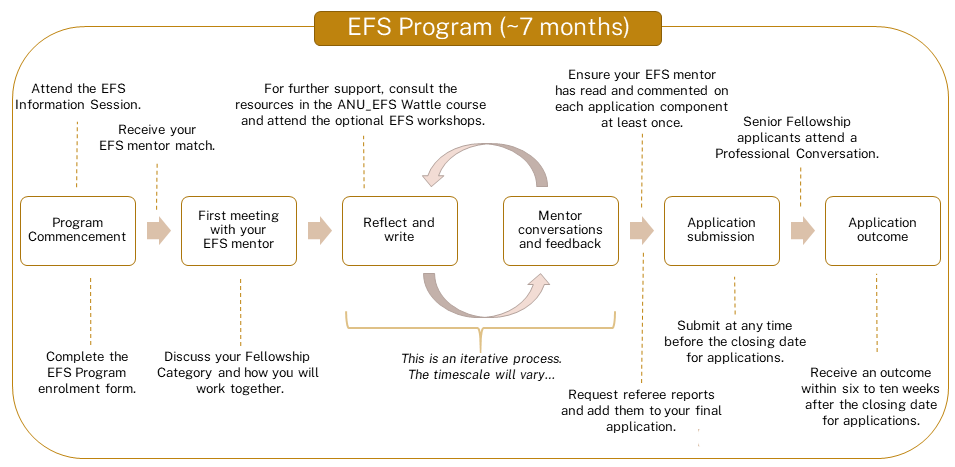
To apply for an AFHEA, FHEA, or SFHEA through the REx pathway, you will need to complete the following steps:
- Attend an ‘EFS information session’ and review the ‘ANU EFS Information booklet’.
Register your interest in these sessions by completing our expression of interest form. You will be contacted via email when the next sessions are scheduled. The ‘ANU EFS Information Booklet’ will be shared at the session. - Review the prerequisites and closing dates of for application submissions.
The closing dates take place in March (for group 2) and September (group 1) each year.
The exact closing dates can be found above (under ‘REx pathway dates’) and in the EFS Wattle course (available to current applicants only). - Submit the Program enrolment form, attaching your draft ‘context statement’.
The link to the enrolment form and information on the context statement are shared at the ‘EFS information session’. - Get matched with an EFS mentor, and complete the AdvanceHE Fellowship Category Tool together.
You will be matched to an EFS mentor shortly after the enrolment closing date for your group, and will be informed of your match via email. - Work with your EFS mentor and the EFS resources as you write the remainder of your EFS application.
The mentorship period takes up to five months, involving a series of consultative meetings. Throughout this period, you will have access to the EFS Wattle course which holds online resources to help you work through your application. - Using the application form, submit your final application as one PDF document – remember to include your referee reports! Senior Fellow applicants will be invited to attend a Professional Conversation after we receive their submission.
Application forms and further information on how to submit can be found in the EFS Wattle course. - Receive your application outcome six to ten weeks after the closing date for application submissions.
You will be notified via email and will then be able to create a ‘My Advance HE’ account and request your Fellowship certificate. For a step-by-step explanation, please consult this guide.
Note that you can submit your application at any time, but you will only receive an application outcome after the next cycle of assessment has taken place. This happens twice a year, in March/April and September/October, and you can expect an outcome by the end of May and the end of November respectively.